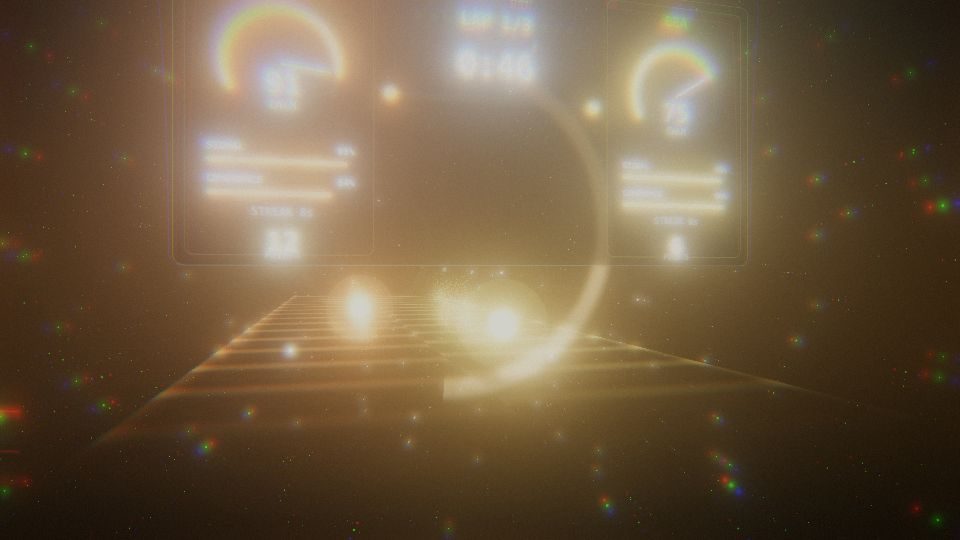
Eight people, eight EEG headbands and one objective: learn what form of meditation works best for your brain. Mind Field leads a group through silence, mantra and music, then lets users complete a maze using nothing but their own mind.
Built by Peter Corbett for a YPO contemplative-technology salon series in NYC
Your mind is the controller.
8 EEG headbands
8 iPhones
1 Mac
1 shared wall
~30 minutes a session
The idea
What if a room could see its own stillness?
Mind Field began as a Beauty Machine drop for private YPO contemplative-technology salons in NYC: small gatherings where a group sits together, practices, and explores what changed. Meditation is usually private and invisible. The question was whether a room full of people could see it, play with it, and take something home.
Each person wears an EEG headband. Every number compares a person with their own two minutes of Alpha brainwaves at quiet rest, and the question it asks is personal: which practice does my mind respond to?
November 20, 2026
Six months of testing, 2,000 engineering hours later…then three sessions, twenty people, every monk home
Mind Field ran three full sessions in November 2026: morning, midday and afternoon. Each took about thirty minutes, with five minutes each of silence, mantra and music before the Maze. Every recording, score and report below was produced by the system on the day. Participants appear only by seat number.
20people across three sessions
20 / 20monks reached the centre of the Maze
92%median share of practice time with a usable signal
48.5 sfastest walk home; the slowest took 124.3 s
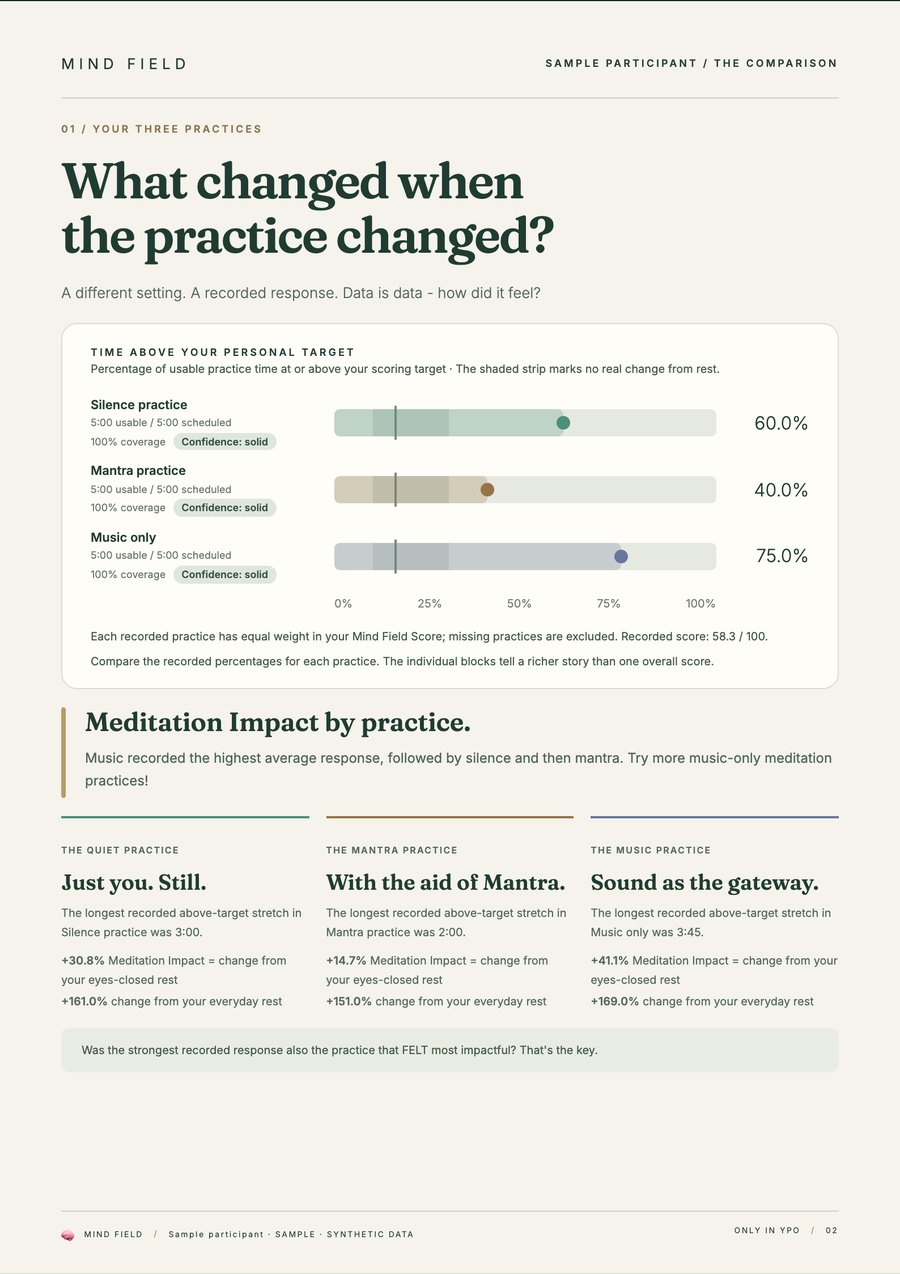
Mind Field Score: share of practice time at or above your own target10 to 30: the range where no real change from rest is likely16: where a score lands if nothing changed
Session A · Morning
7 people · 30 minutes · Maze completed by all 7 in 102.7 s
Session A leaderboard by seat number
Rank
Seat
Mind Field Score %
Silence %
Mantra %
Music %
Home
1
P04
34.0
37.6
32.5
32.0
3rd · 69.6 s
2
P02
20.6
19.4
17.8
24.6
4th · 72.5 s
3
P01
16.5
12.9
18.3
18.4
6th · 82.4 s
4
P03
5.9
9.5
5.6
2.6
1st · 61.8 s
5
P05
3.0
0.4
2.7
6.0
2nd · 67.1 s
6
P07
1.6
0.3
1.1
3.3
7th · 102.4 s
7
P06
1.3
1.5
0.9
1.6
5th · 81.9 s
Session B · Midday
7 people · 30 minutes · Maze completed by all 7 in 102.2 s
Session B leaderboard by seat number
Rank
Seat
Mind Field Score %
Silence %
Mantra %
Music %
Home
1
P05
31.4
30.4
30.5
33.3
2nd · 63.8 s
2
P04
16.7
16.9
16.3
16.8
6th · 94.7 s
3
P06
8.7
9.0
6.2
11.0
5th · 77.8 s
4
P07
6.8
4.5
13.1
2.7
1st · 61.2 s
5
P01
6.1
3.6
9.9
4.7
7th · 101.8 s
6
P02
5.2
5.8
4.4
5.3
3rd · 68.4 s
7
P03
0.4
1.1
0.2
0.0
4th · 71.4 s
Session C · Afternoon
6 people · 30 minutes · Maze completed by all 6 in 124.6 s
Session C leaderboard by seat number
Rank
Seat
Mind Field Score %
Silence %
Mantra %
Music %
Home
1
P06
19.7
13.9
25.3
19.8
1st · 48.5 s
2
P03
18.1
21.1
23.0
10.1
3rd · 76.7 s
3
P05
12.7
15.5
11.6
11.0
6th · 124.3 s
4
P04
5.6
11.3
3.3
2.3
2nd · 70.8 s
5
P01
2.7
2.3
4.9
0.9
4th · 86.2 s
6
P02
1.5
1.1
1.6
1.9
5th · 92.6 s
Scores are each person's percentage of usable practice time at or above a personal target set from their own eyes-closed rest; the no-change mark and band are provisional settings. The three practice columns give the same percentage for each practice. "Home" is the order in which each monk reached the centre, and the time it took. Confidence was rated "solid" for 10 of the 60 practices and "shaky" for the rest; by design only the first practice can be solid.
What the day showed
Findings from twenty people
The baseline
A quiet rest is a high bar
46 of the 60 practices read below the person's own eyes-closed rest. Twelve of twenty people scored under 10. Sitting still with your eyes closed already produces strong alpha rhythm, and practising does not automatically beat it.
The practices
No single practice won
Each person's strongest practice split 8 for music, 7 for silence and 5 for mantra. That is the point of comparing yourself with yourself: different minds answer to different things.
The Maze
Everyone got home
All three rounds ended with every monk at the centre, in 103, 102 and 125 seconds. Because each monk walks on its own signal, nobody was carried and nobody held the group back.
Play vs. practice
Walking fast is a different skill
How quickly a monk got home had little to do with the practice score (rank correlation −0.24). The game rewards finding and holding your own rhythm in the moment; the score summarises fifteen quiet minutes.
The experience
Three chapters in one sitting
01
Map your mind
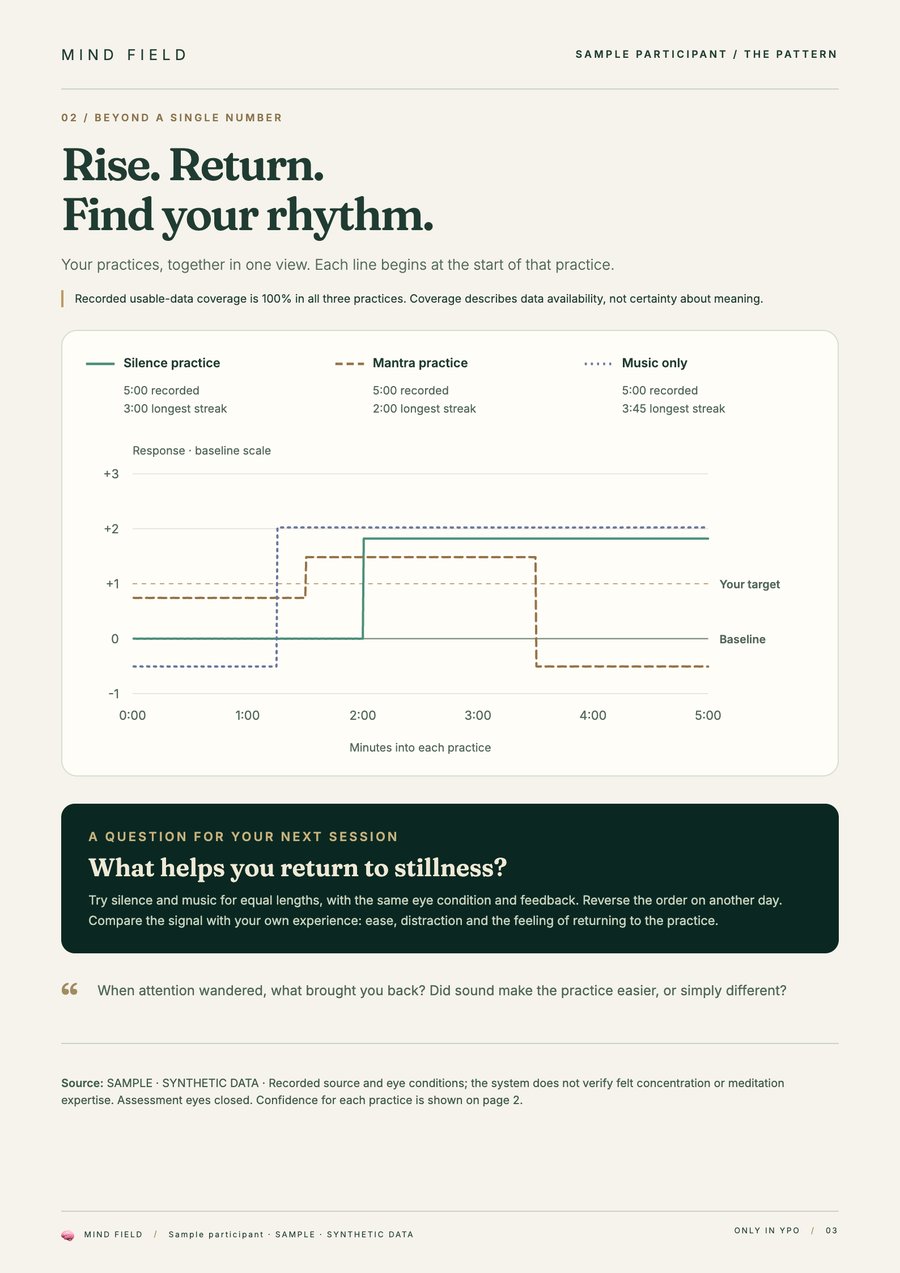
After a fit check and two minutes of eyes-closed rest, the group practises three ways: in silence, with a mantra, and with music. The system records how each person's brainwave response changes.
02
Move a world together
Eyes open. Each person's signal walks one monk through the Mind Field Maze toward a red ensō at the centre. When all of them arrive, the room reaches Total Enlightenment.
03
Take your mind map home
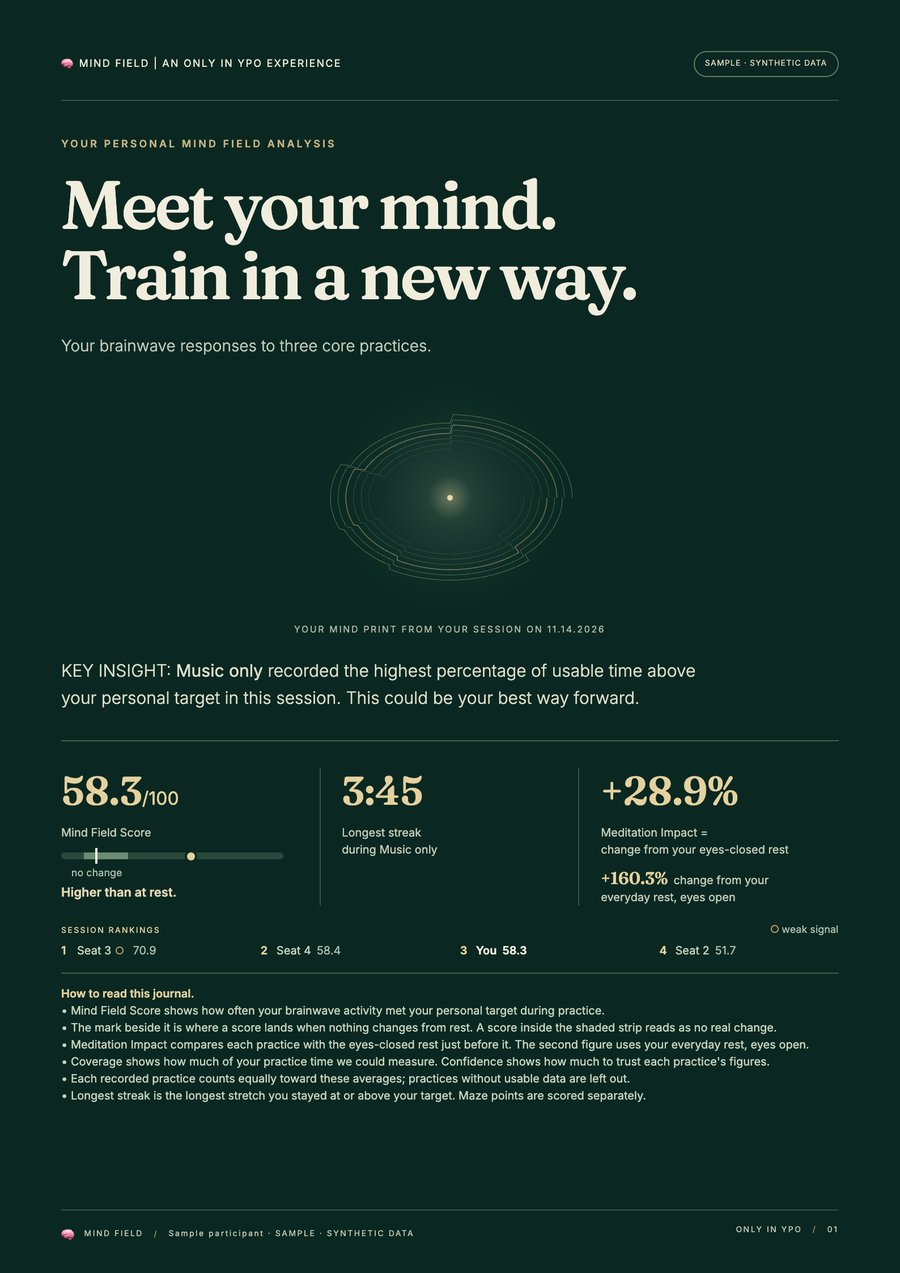
Everyone leaves with a personal Field Journal: a PDF of their own patterns across the three practices and their part in the shared journey.
Fit · 3
Rest · 2
Silence · 5
Mantra · 5
Break · 3
Music · 5
Maze · 3
Practice, eyes closedFit check, rest and breaksThe Maze, eyes openMinutes, as run on November 20
The room
A quiet wall and one facilitator
The room sees a single projected wall. During practice it shows a quiet field: numbered seats in a circle, each ring brightening as that person's signal responds. No names, numbers or scores appear on it.
A facilitator runs the session from a separate screen and starts each step by hand. That screen shows every seat's headband fit and signal, and plays the bells and the music. The wall itself stays silent.
The wall during silent practice. Synthetic rehearsal.
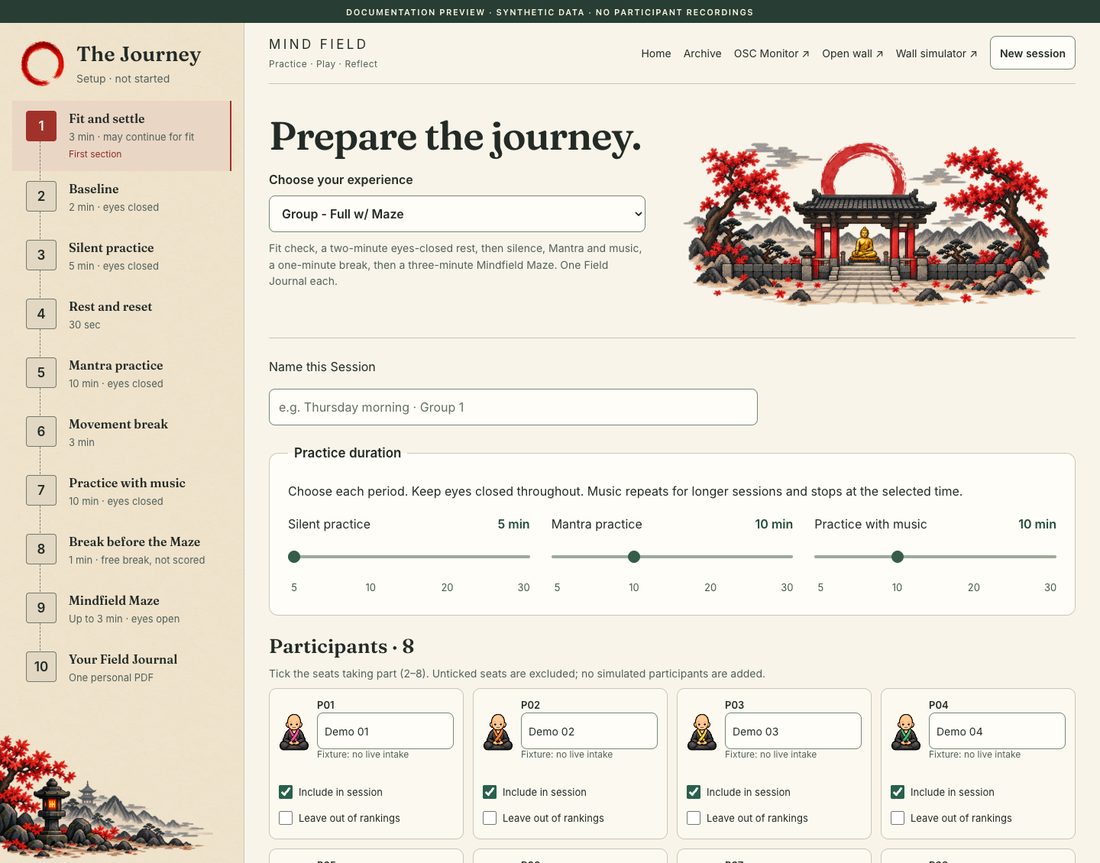
The facilitator's screen
Running the room from one screen
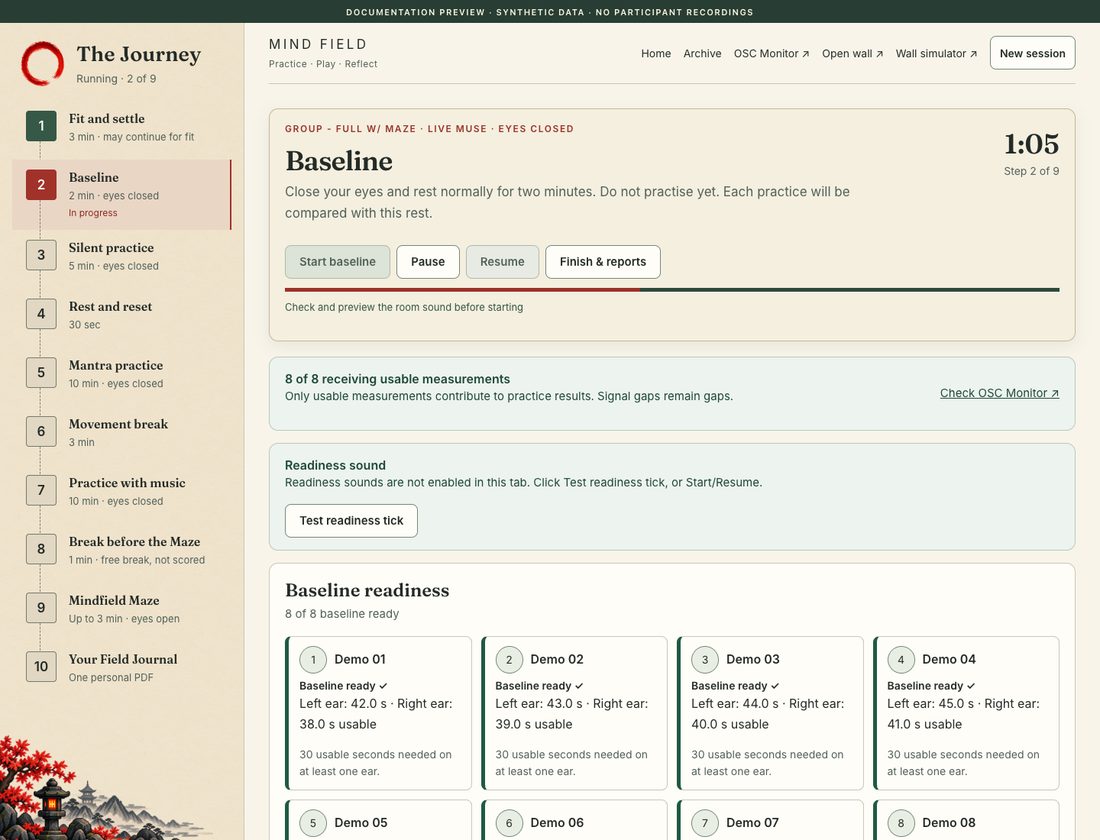
The facilitator works from a laptop beside the wall. A sidebar lists the whole journey, and every step starts by hand, so the room moves when the people in it are ready. The first job, and the hardest, is getting eight headbands to fit.
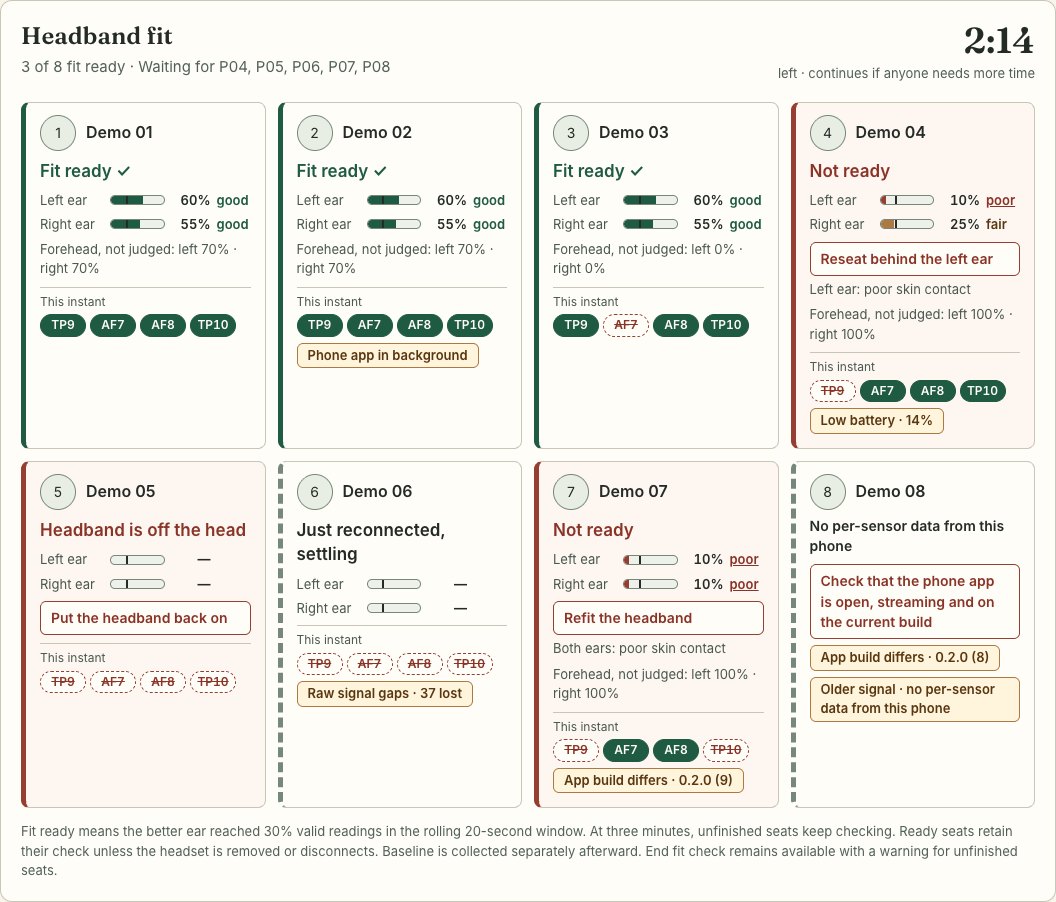
The fit check for eight seats. Synthetic data, invented names. Tap to enlarge.
Reading the fit check
TP9 and TP10 are the sensors behind the ears and decide the fit; AF7 and AF8 on the forehead are shown but not judged. A solid green light means a usable reading right now; a dashed, struck-through one means not.
The bars show how much of the last twenty seconds each ear read cleanly. A headband is ready when its better ear reaches 30%, so a sensor that drops out for a moment doesn't change the verdict.
What the seats above are saying
3Ready, even though a forehead sensor is out right now.
4Not ready: the left ear reads 10%. One instruction: reseat behind the left ear.
5The headband is off. Every light is out.
6Just reconnected, so it waits for a verdict instead of guessing one.
8An older phone that sends no per-sensor data, so no verdict is invented.
Setup: choose the experience, practice lengths and seats.Baseline: each seat counts usable seconds per ear. Thirty are needed on at least one.
A round of the Maze, about 25 seconds, ending in Total Enlightenment. Synthetic rehearsal, sped up.
When a person's signal rises above their own recent level, their monk walks; when it falls, the monk rests where it stands. Thirty-six seconds of walking reaches the centre, inside a three-minute round. The signal is smoothed over a couple of seconds, and a monk keeps walking through a dropout of up to three seconds. That small allowance is what made the game playable on consumer hardware.
The Field Journal
A report that refuses to overclaim
Each participant receives a personalized PDF report of their session. It shows time above their own target in each practice, how each practice compared with their opening rest, and a confidence label for each practice. Where the signal was too weak to score, it says so and leaves the number out. A Maze page and an appendix of plain-English notes and charts from the person's own raw recording follow.
How it worked
From a forehead to a wall
× 8
Muse headband
Four dry sensors: one behind each ear, two on the forehead. Scores use the two ear sensors.
× 8
iPhone
One per headband. A small app reads the headband over Bluetooth and streams every reading, including the raw signal, over Wi-Fi.
× 1
Mac
Receives all eight streams, judges each sensor reading, runs the session, records it and writes the reports.
× 1
Wall and facilitator
A browser page on the projector for the room and another for the facilitator. Everything runs locally.
Every message carries a sequence number, so lost packets show up instead of hiding. A reading is only used when the sensor is on the head, recent, changing and in contact. Headband fit is judged over the last twenty seconds rather than one instant, and gaps in the data stay gaps: nothing is filled in or estimated.
The road there
Six months, many versions
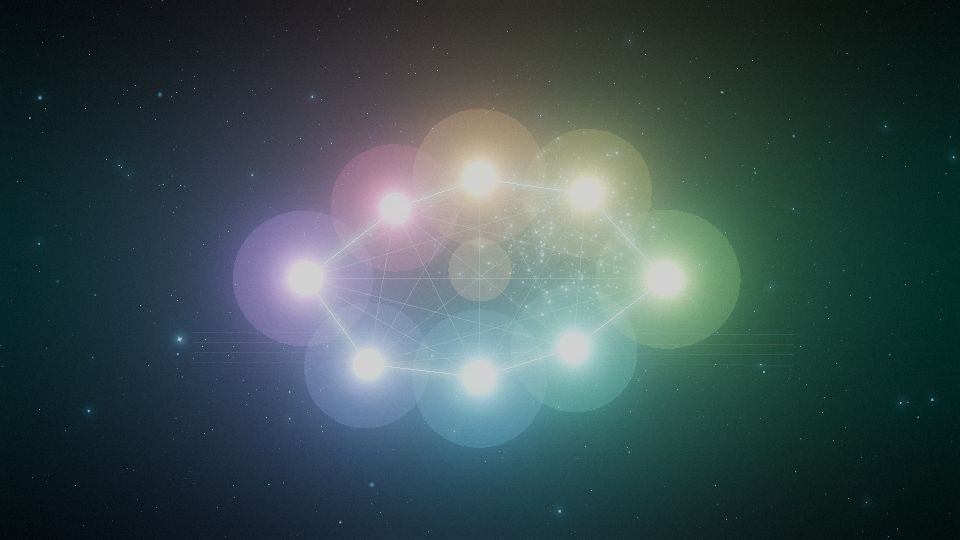
An early projection world: the mandala.Eight lights, one per person, gathering.The Duel: two people, one arena.
MayStart
Simulator first
The whole system was built against eight simulated headsets before any hardware arrived, so every screen and report could be rehearsed.
JuneProjection
A room that responds
Projected worlds such as mandalas, pools of light and a gathering of eight lights, plus stage lighting that followed the room. The lighting was later switched off.
JulyHardware
One phone per headband
A dedicated iPhone app replaced off-the-shelf streaming, so eight headbands could stream to one Mac reliably.
AugustHardening
Recovery, security and reports
Crash-safe recording, recovery after a failure, private operator access and the first participant reports.
SeptemberPlay
Games for eight
Duels, a regatta, a sea creature and a garden: experiments in what a group can do with its signals. Most were retired.
OctoberThe Journey
Silence, mantra, music, Maze
The experience settled into its final shape: three practices, the Mindfield Maze and a personal Field Journal.
NovemberRelease
Rebuilt capture and the first groups
Per-sensor signal checks, raw EEG recording, a rolling fit check and new phone software, then version 1.0 on November 19 and three group sessions the next day.
Key take-aways for other builders
Field notes for anyone building with consumer EEG
Fit
A good fit still flickers
A well-fitted ear sensor reads valid only a little over half the time, in bursts of a few seconds. Judge fit over the last twenty seconds, never on one instant.
Sensors
Sensors can fail quietly
With poor contact, a headband can keep repeating the same value. Detect stuck readings and treat them as no reading at all.
Data
Never invent missing data
Gaps stay gaps, in the recording and in the score. A person with too little usable signal gets no number instead of an estimated one.
Scoring
Compare people with themselves
Measure each practice against that person's own rest, and say which rest: eyes open and eyes closed are different baselines, and an eyes-closed rest is a demanding one.
Play
Make the game forgiving, not fake
Smooth the signal, adapt to each player's own recent level, and coast through short dropouts. The mechanic is tuned so a typical player is "on" about half the time.
The room
One facilitator, eight heads
The person running the room needs one plain instruction per seat, such as "reseat behind the left ear". Advice should inform them and never stop the session.
Evidence
What was and wasn't shown
Shown
Three complete group sessions, twenty people, with recording, scoring, reports and the Maze working end to end.
Usable signal for most of the practice time for most people, with a median of 92%.
A game that every participant finished.
Not shown
That the score measures meditation quality. It describes a change in brain rhythm against a person's own rest.
That one practice is better than another for anyone but the person on that day.
Any medical or therapeutic effect. Mind Field is not a medical device.
How it was built
One person, directing AI coding agents
6months, May to November 2026
5+billion tokens
2,000+human-equivalent engineering hours
400+GitHub commits
For builders
The parts worth taking
The whole installation is hard to open source. A few small pieces are not, and they are the ones I would share with anyone working with Muse headbands or other consumer EEG.
sensor-validity
Decides, reading by reading, whether a sensor can be trusted.
fit-window
A rolling twenty-second headband fit check with one instruction per seat.
seq-tracker
Counts lost and repeated messages across many phones on Wi-Fi.
game-signal
Turns a noisy brain signal into an on/off control a game can use.